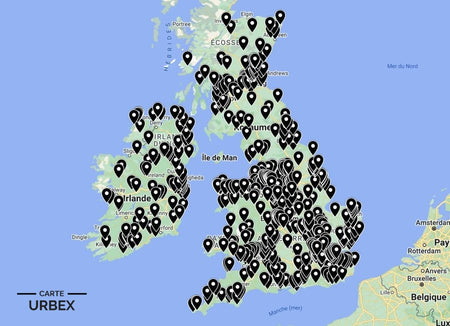
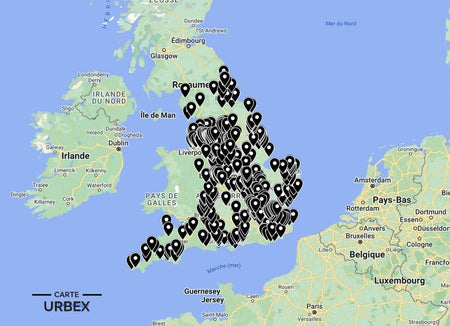
Reading is the Thames Valley's commercial capital — a prosperous commuter town whose Victorian identity was built on Huntley and Palmers biscuits, Suttons seeds and the brewing industry that made it "the three Bs town." Its abandoned places carry that Victorian commercial confidence: the Grade II listed biscuit factory that fed the British Empire, the Victorian prison where Oscar Wilde wrote The Ballad of Reading Gaol and the psychiatric hospital that served Berkshire's most vulnerable for over a century. Here are 5 of the best abandoned places in Reading, selected from our Abandoned Places Map UK — 640+ GPS locations across England, Scotland, Wales and Ireland.
Why Reading Is a Hidden Gem for Urban Exploration
Reading's urbex landscape is anchored by its extraordinary Victorian industrial and institutional heritage — a biscuit factory that fed the world, a prison that held one of literature's greatest writers and a psychiatric hospital campus in the Thames Valley. Beyond the town centre, the Berkshire and Oxfordshire countryside adds country house dereliction and WWII airfield infrastructure to a Thames Valley urbex geography that most explorers bypass on their way to London.
1. Huntley & Palmers Factory – King's Road, Reading — 1846-1976 Biscuit Factory, Once Largest in the World, Grade II Listed Buildings, Partially Abandoned (Known Location)
Huntley and Palmers' King's Road factory in Reading was at its Victorian peak the largest biscuit factory in the world — producing biscuits for the British Empire from Reading since 1846 and employing up to 6,000 workers on a site that stretched along the Kennet. The factory closed in 1976; significant Grade II listed Victorian factory buildings remain on the King's Road site in various states of atmospheric dereliction and partial conversion. The original factory architecture — the ornate Victorian industrial brick, the loading dock infrastructure and the Kennet waterfront — make Huntley and Palmers one of the most historically significant and most architecturally distinguished pieces of derelict commercial heritage in the Thames Valley.
🔗 Learn more: Wikipedia – Huntley and Palmers Reading
2. Reading Gaol – Forbury Road, Reading — 1844 Victorian Prison, Oscar Wilde Imprisoned 1895-1897, Empty Since 2013, Grade II* Listed (Known Location)
Reading Gaol on Forbury Road is one of the most historically literary of all English prisons — an 1844 Victorian radial prison where Oscar Wilde was imprisoned from 1895 to 1897, writing the letter later published as De Profundis and the inspiration for The Ballad of Reading Gaol. The prison closed in 2013 and has been empty since, its Grade II* listed Victorian Gothic exterior and the original cell block interior in progressive atmospheric dereliction while various plans for conversion have repeatedly stalled. The combination of the extraordinary literary significance and the Victorian Gothic architecture make Reading Gaol one of the most discussed at-risk heritage buildings in England.
🔗 Also read: Top 5 Abandoned Places in England →

3. Prospect Park Hospital – Tilehurst, Reading — 1870 Berkshire County Pauper Lunatic Asylum, Gothic Water Tower and Chapel, Partially Derelict, Listed by British Listed Buildings (Known Location)
Prospect Park Hospital in Tilehurst was opened in 1870 as the Berkshire County Pauper Lunatic Asylum — a complete Victorian Gothic institutional campus whose water tower, chapel and ward buildings served Reading's psychiatric population for over a century. Sections of the original campus remain in atmospheric dereliction as the site has been progressively developed. Listed by British Listed Buildings as architecturally significant; the Gothic water tower is the most distinctive surviving element of the original Victorian asylum design.
🔗 Learn more: British Listed Buildings – Reading Heritage
4. Berkshire WWII Airfield – 1940s Fighter or Bomber Station, Control Tower and Dispersal Pans, Thames Valley Setting (Only on Our Map)
A 1940s RAF operational station in the Berkshire countryside near Reading — the original control tower still standing above the surrounding farmland, blast pen aircraft protection structures and Nissen hut technical site buildings scattered across the former airfield. The Thames Valley's flat agricultural landscape was prime wartime airfield territory; several stations were built within easy range of London and the Channel. GPS coordinates available with our England Urbex Map.
5. Thames Valley Georgian Country House – 18th-Century Mansion, Grand Staircase and Library Intact, Stable Block and Walled Garden, Berkshire (Our Map Exclusive)
An 18th-century country house in the Berkshire Thames Valley — the original grand staircase still intact, the library with period shelving and the servants' wing with bells and call board. The stable block and walled kitchen garden still stand in the overgrown grounds. Post-war death duties and the agricultural depression emptied several Berkshire estates within a decade of 1945. Included in our England collection — 400+ locations.
❓ FAQ
What is the most famous abandoned place in Reading?
Reading Gaol — an 1844 Victorian prison where Oscar Wilde was imprisoned from 1895 to 1897, writing what became De Profundis and inspiring The Ballad of Reading Gaol. Empty since 2013, Grade II* listed, with conversion plans repeatedly stalled.
What was Huntley and Palmers?
At its Victorian peak the largest biscuit factory in the world — established in Reading in 1846 and employing up to 6,000 workers producing biscuits shipped across the British Empire. The Grade II listed King's Road factory buildings remain in various states of dereliction along the Kennet waterfront.
Why was Oscar Wilde imprisoned in Reading?
Wilde was convicted of gross indecency in May 1895 and sentenced to two years' hard labour. He served the final part of his sentence at Reading Gaol from November 1895 to May 1897; the experience destroyed his health and produced his two most personally revealing late works.
Safety Tips
- Reading Gaol is fenced off — observe from outside only; do not attempt to access the site, which is actively secured
- Asbestos: endemic in pre-1980 Reading industrial and hospital buildings — FFP2 mask mandatory in any enclosed space
- Never explore alone — always bring at least one other person
The urbex code: "Take nothing but photographs, leave nothing but footprints."
🎯 Summary
Reading's abandoned places range from the world's largest Victorian biscuit factory on the Kennet to the Grade II* listed prison where Oscar Wilde was imprisoned and the 1870 asylum whose Gothic water tower still defines the Tilehurst skyline. Each of these 5 derelict buildings in Reading captures a different layer of the Thames Valley town that built an empire on biscuits and brewing.

Abandoned Places Map England
- ✓ 400+ GPS locations across England
- ✓ Exclusive locations not found anywhere else
- ✓ Instant access after purchase
- ✓ Free updates forever
14,99€
Explore All Locations →