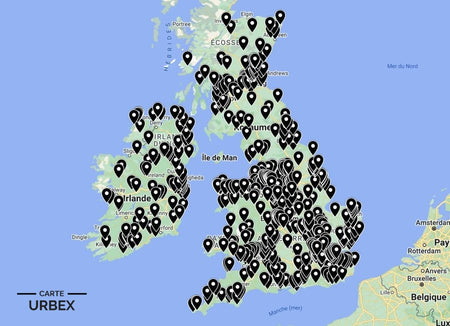
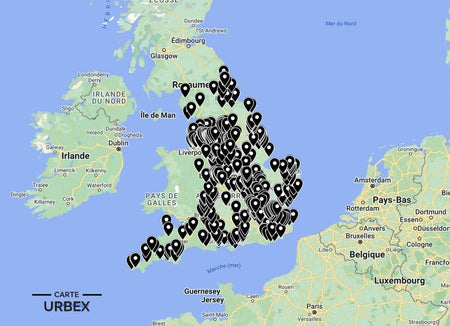
Stoke-on-Trent is the Potteries — six towns merged into one city whose entire identity was built around the bottle kiln, the potbank and the names that defined world ceramics for two centuries: Wedgwood, Spode, Royal Doulton, Minton. At its Victorian peak the city had over 2,000 bottle kilns firing simultaneously; today just 47 survive, many in various states of atmospheric dereliction. Combined with the Staffordshire coalfield's abandoned colliery infrastructure and the Victorian institutional heritage of a city that built for its industrial workforce, Stoke offers an urbex landscape unlike anywhere else in England. Here are 5 of the best abandoned places in Stoke-on-Trent, selected from our Abandoned Places Map UK — 640+ GPS locations across England, Scotland, Wales and Ireland.
Why Stoke-on-Trent Is a Hidden Gem for Urban Exploration
Stoke's urbex density is exceptional — a city where derelict potbanks, abandoned collieries and Victorian institutional buildings coexist within a few square miles. The Potteries' collapse left a concentration of large-scale industrial abandonment that is unique in England: the pottery kiln is a building typology found nowhere else, and Stoke has more surviving examples in various states of dereliction than the rest of England combined. The 28DaysLater Staffordshire community and the dedicated UrbexBaby blog document Stoke's derelict landscape in extraordinary depth.
1. Chatterley Whitfield Colliery – Chell, Stoke-on-Trent — 1860s-1977 North Staffordshire Coalfield, Once Largest Coal Producer in Britain, Scheduled Ancient Monument, Buildings Abandoned Since 1993 (Known Location)
Chatterley Whitfield Colliery near Stoke-on-Trent is the most historically significant abandoned colliery in the Midlands — a mine that at its peak produced more coal than any other in Britain and was later the country's most famous mining museum before the museum closed in 1993. Now a Scheduled Ancient Monument, the pithead baths of 1936-37 in Modernist style by the Miners' Welfare Committee, the winding house of 1915, the canteen and the surface infrastructure of one of Britain's most extraordinary colliery complexes stand in atmospheric dereliction on the North Staffordshire plateau. Listed by Historic England as nationally significant.
🔗 Learn more: Wikipedia – Chatterley Whitfield Colliery
2. North Staffordshire Royal Infirmary – Hartshill, Stoke-on-Trent — Victorian Hospital Campus, Ward Buildings and Chapel, Partially Abandoned, Documented on Derelict Places (Known Location)
The North Staffordshire Royal Infirmary on Hartshill Road is a Victorian hospital campus that served the Potteries workforce for well over a century — the original ward buildings, the hospital chapel and the administrative block in various states of dereliction as the NHS has progressively consolidated services on the modern University Hospital of North Midlands site. Documented on Derelict Places as one of the most extensively explored and most atmospherically complete derelict hospital campuses accessible from Stoke.
🔗 Also read: Top 5 Abandoned Places in England →

3. John Tams Crown Pottery – Longton, Stoke-on-Trent — 1874 Pottery Factory, Closed 2000, Fire-Damaged 2014, Industrial Kilns and Ceramic Transfers Still Present, Documented on UrbexBaby (Known Location)
John Tams Crown Pottery on Commerce Street in Longton opened in 1874 as an earthenware factory producing hotel and pub ware — operating until 2000 and then deliberately fire-damaged in 2014, leaving sections needing urgent demolition while others remain in extraordinary atmospheric dereliction. The large industrial kilns are still fitted into the building; thousands of ceramic transfers remain strewn across the factory floor alongside office wage dockets and invoices. One of the most completely documented and most evocatively detailed abandoned pottery factories in the Potteries, reported extensively on UrbexBaby.
🔗 Learn more: UrbexBaby – Stoke-on-Trent Urbex Reports
4. Staffordshire Bottle Kiln Potbank – 1880s-1960s Pottery Works, Bottle Kiln Still Standing, Saggar House and Slip House, Longton or Burslem (Off the Radar — Our Map Only)
An 1880s-1960s bottle kiln potbank in the Potteries — the original bottle kiln still standing above the surrounding rooflines, the saggar house where fireclay saggars were made to protect pottery during firing and the slip house where raw clay was processed into workable slip. Of the 2,000+ bottle kilns that once fired in Stoke, only 47 survive; the derelict examples with their original potbank infrastructure intact are the rarest and most historically significant pieces of abandoned architecture in the city. GPS coordinates available with our England Urbex Map.
5. Twyford House – Etruria, Stoke-on-Trent — Former Industrial Building, Long-Term Derelict, A500 Landmark, Ceramic Valley Enterprise Zone (Exclusively on Our Map)
Twyford House on the Etruria roundabout is one of Stoke's most visible derelict landmarks — a former industrial building visible from the A500 whose broken windows have been a defining feature of the city's approach for over fifteen years. Located in the Ceramic Valley Enterprise Zone, the building has been the subject of repeated enforcement action over illegal waste storage and multiple regeneration promises that have not materialised. The most discussed and most debated derelict building in Stoke. Find it on our map — with access rating and condition report.
Safety Tips
- Fire damage: John Tams Crown Pottery and other fire-damaged Longton potbanks have structurally weakened sections — always assess overhead elements before entry and avoid areas with visible roof collapse
- Mine shafts: the North Staffordshire coalfield has numerous capped and uncapped shafts — never approach any ground depression near Chatterley Whitfield or any colliery site
- Never explore alone — always bring at least one other person
The urbex code: "Leave it as you found it — the next explorer deserves the same experience."
❓ FAQ
What is the most famous abandoned place in Stoke-on-Trent?
Chatterley Whitfield Colliery — a North Staffordshire mine that was once the largest coal producer in Britain, later Britain's most visited mining museum before closing in 1993. Now a Scheduled Ancient Monument, with 1936 Modernist pithead baths by the Miners' Welfare Committee listed by Historic England as nationally significant.
How many bottle kilns survive in Stoke?
Of the over 2,000 bottle kilns that fired simultaneously at the Potteries' Victorian peak, just 47 survive today — many in various states of dereliction. The bottle kiln is a building typology found nowhere else on earth in this concentration; the surviving examples are the most distinctive piece of Stoke's abandoned architectural heritage.
Why did the Potteries decline?
The Stoke ceramics industry faced competition from cheaper overseas production through the 20th century, combined with changing consumer tastes and the energy cost of bottle kiln firing. The Clean Air Acts of the 1950s-1960s accelerated kiln closures; the larger firms that converted to tunnel kilns survived while smaller potbanks simply closed.
🎯 Summary
Stoke-on-Trent's abandoned places range from a Scheduled Ancient Monument colliery with 1936 Modernist pithead baths to a pottery factory with kilns still in situ and thousands of ceramic transfers on the floor. Each of these 5 derelict buildings in Stoke-on-Trent captures a different layer of the Potteries — a city that made the world's finest ceramics and is still surrounded by the buildings that fired them.

Abandoned Places Map England
- ✓ 400+ GPS locations across England
- ✓ Exclusive locations not found anywhere else
- ✓ Instant access after purchase
- ✓ Free updates forever
14,99€
Explore All Locations →