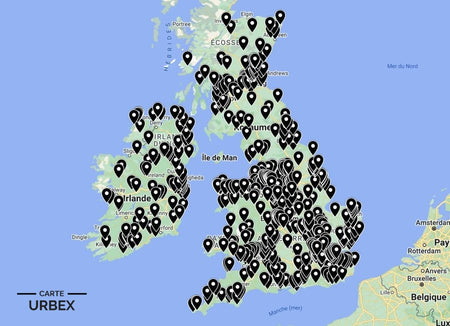
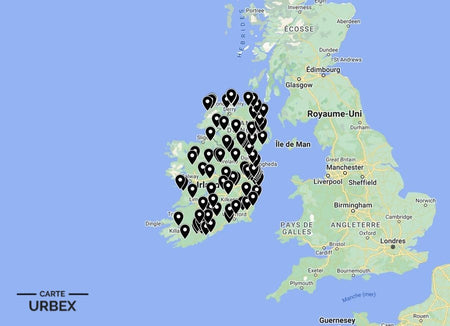
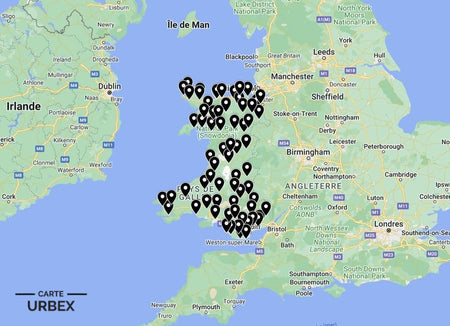
Cork is Ireland's second city and the Republic's southern capital — a Lee valley port city whose commercial and industrial heritage spans from medieval trade to Victorian gunpowder manufacture to the post-war hotel and hospitality boom. Its abandoned places carry that extraordinary range: a gunpowder factory that supplied the British Army from 1794 to 1903 and now stands in remarkable atmospheric dereliction in the Lee valley, a Georgian hotel abandoned in the Cork countryside and the medieval priory ruins of the river valleys south of the city. Here are 5 of the best abandoned places in Cork, selected from our Abandoned Places Map Ireland — 100+ GPS locations across Ireland.
Why Cork Is a Hidden Gem for Urban Exploration
Cork's urbex landscape is defined by the Lee valley's industrial heritage — the gunpowder mills, textile works and distilleries that made the Lee corridor one of the most industrially diverse river valleys in Ireland — combined with the country house and ecclesiastical heritage of the Cork countryside. The Irish urbex community visits Cork less frequently than Dublin; significant sites remain underdocumented.
1. Ballincollig Gunpowder Mills – Ballincollig, Cork — 1794-1903 Royal Gunpowder Mills, Largest Gunpowder Factory in Ireland, Incorporating Mills and Magazine Buildings in Atmospheric Dereliction (Known Location)
The Ballincollig Gunpowder Mills on the River Lee west of Cork were established in 1794 as the Royal Gunpowder Mills — the largest gunpowder manufacturing complex in Ireland, supplying the British Army through the Napoleonic Wars, the Crimea and the Indian Mutiny until closure in 1903. The incorporating mills, magazine buildings, workers' housing and canal infrastructure remain in remarkable atmospheric dereliction in the Lee valley, now within a heritage park whose scale and historical completeness make it one of the most extraordinary pieces of military-industrial archaeology in Ireland.
🔗 Learn more: Wikipedia – Ballincollig Gunpowder Mills Cork
2. Innishannon House Hotel – Innishannon, Co Cork — Georgian Country House Abandoned After Hotel Closure, Grand Staircase and Ballroom, Bandon River Setting (Known Location)
Innishannon House on the Bandon River is a Georgian country house that served its final years as a hotel before abandonment — the original grand staircase still intact, the ballroom floor and the principal rooms in atmospheric dereliction in the south Cork countryside. Georgian country houses converted to hotels and subsequently abandoned are among the most atmospherically complete pieces of Irish abandoned heritage; the combination of the Bandon river setting, the Georgian architectural quality and the hotel fittings left in situ create a time-capsule quality unique in Cork urbex.
🔗 Also read: Top 5 Abandoned Places in Ireland →

3. Kilbrittain Castle – Kilbrittain, Co Cork — Medieval Tower House on the Argideen River, Abandoned, Documented by discover.re Ireland (Known Location)
Kilbrittain Castle on the Argideen River in south Cork is a medieval tower house whose atmospheric ruins rise above the river valley in the west Cork countryside — an abandoned piece of medieval Irish defensive architecture whose tower, bawn walls and river valley setting create one of the most romantically atmospheric castle ruin experiences in the Cork countryside. Documented by discover.re as one of the most accessible and most atmospheric of west Cork's abandoned medieval castle heritage.
🔗 Learn more: discover.re – Cork Abandoned Places Ireland
4. West Cork Famine-Era Workhouse – 1840s Union Workhouse, Fever Hospital and Casual Ward, West Cork Rural Setting (Our Map Exclusive)
An 1840s Union Workhouse in the west Cork countryside — the fever hospital block where famine victims died in their thousands, the casual ward and the master's house of a workhouse that served as the last resort for hundreds of thousands of Cork people during the Great Famine of 1845-1852. Cork was one of the most severely affected counties; the Union workhouses of west Cork carry a historical weight that gives their dereliction an emotional charge unique in Irish abandoned heritage. GPS coordinates available with our Ireland Urbex Map.
5. Cork Lee Valley Distillery – 19th-Century Whiskey Distillery, Malt House and Still House Ruins, River Lee Setting (Hidden Gem — Our Map Only)
A 19th-century whiskey distillery in the Lee valley — the malt house where barley was germinated and dried over peat fires, the still house and the bonded warehouse of a distillery that produced Cork whiskey for the British and American markets at the height of Irish whiskey's global dominance. The Lee valley's distilling heritage has been progressively rediscovered as the Irish whiskey revival accelerates; the derelict examples are the most atmospherically complete and most historically specific pieces of Cork industrial heritage. Find it on our map — with access rating and condition report.
❓ FAQ
What is the most famous abandoned place in Cork?
Ballincollig Gunpowder Mills — the largest gunpowder manufacturing complex in Ireland, established in 1794 and supplying the British Army through the Napoleonic Wars, the Crimea and the Indian Mutiny until closure in 1903. The incorporating mills, magazine buildings and canal infrastructure are among the most completely surviving pieces of military-industrial archaeology in Ireland.
What makes Ballincollig Gunpowder Mills unusual architecturally?
Gunpowder mill architecture is unique among industrial building types — every design decision is driven by the imperative to contain any accidental explosion. The incorporating mills are low-profile, earth-banked and separated from one another by blast walls; the magazine buildings have thick stone walls and copper fittings (to prevent sparks); the canal provided power and water without the spark risk of steam. The result is an industrial landscape unlike anything else in Irish heritage.
What was the Great Famine's impact on Cork?
Cork was one of Ireland's most severely affected counties during the Great Famine of 1845-1852 — the county's population fell from approximately 800,000 to under 550,000 through death and emigration. Cork's west and rural districts were among the worst affected; Skibbereen in west Cork became internationally synonymous with famine suffering. The Union workhouses that served as the last resort for starving families are among the most emotionally charged pieces of derelict heritage in Ireland.
Safety Tips
- Gunpowder residue: Ballincollig Mills may retain trace explosive residues in soil — never disturb ground surfaces or any material inside mill buildings; never introduce any ignition source
- Unstable masonry: Cork castle and priory ruins have centuries of weathering — always assess overhead stability and stay back from any cracked or leaning masonry
- Never explore alone — always bring at least one other person
The urbex code: "Leave it as you found it — the next explorer deserves the same experience."
🎯 Summary
Cork's abandoned places range from a Napoleonic gunpowder factory that supplied the British Army for over a century to a Georgian country house hotel abandoned on the Bandon River and a medieval tower house rising above the Argideen valley. Each of these 5 derelict buildings in Cork captures a different layer of Ireland's second city and its extraordinary southern countryside.

Abandoned Places Map Ireland
- ✓ 100+ GPS locations across Ireland
- ✓ Exclusive locations not found anywhere else
- ✓ Instant access after purchase
- ✓ Free updates forever
9,99€
Explore All Locations →