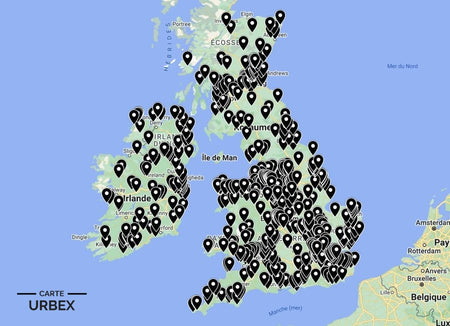
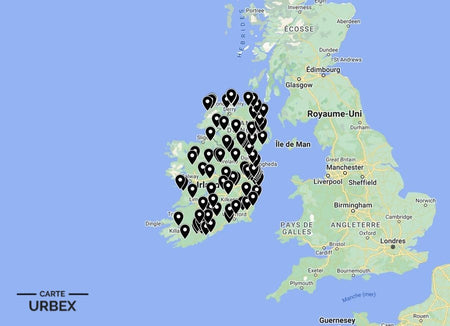
Dublin is Ireland's capital and largest city — a Georgian port city on the Liffey estuary whose 18th-century urban fabric, Victorian industrial heritage and 20th-century institutional buildings create one of the richest and most varied abandoned landscapes in the British Isles. Its derelict places carry the full range of Irish history: a magazine fort in Phoenix Park where Éamon de Valera's men sheltered during the War of Independence and where WWII-era munitions were stored, a Victorian cigarette factory whose closure left a South Circular Road landmark empty for decades and a Liffey estuary fortification whose Georgian masonry still rises above Dublin Bay. Here are 5 of the best abandoned places in Dublin, selected from our Abandoned Places Map Ireland — 100+ GPS locations across Ireland.
Why Dublin Is a Hidden Gem for Urban Exploration
Dublin's urbex landscape is defined by the tension between the city's extraordinary historic fabric — preserved Georgian streetscapes, Victorian industrial buildings and early 20th-century institutional architecture — and the development pressure of one of Europe's fastest-growing capital cities. The Irish urbex community documented many of Dublin's most significant abandoned buildings before redevelopment; what remains is the more resilient layer of military heritage and institutional dereliction that economic growth cannot easily absorb.
1. Phoenix Park Magazine Fort – Dublin — 1735 Military Ammunition Store, Used During War of Independence and WWII, Still Derelict, Documented by Abandoned World Photography (Known Location)
The Phoenix Park Magazine Fort is one of Dublin's most historically charged derelict sites — a 1735 military fortification and ammunition store in the heart of Phoenix Park that played a role in both the 1916 Rising (raided by the IRA) and the War of Independence, when Éamon de Valera's men used the area as a refuge. Still standing derelict within the park boundaries, the Magazine Fort's 18th-century fortification masonry, its IRA raid connection and its continuing atmospheric dereliction in Ireland's largest urban park make it one of the most historically resonant and most unusual pieces of military heritage accessible from Dublin city centre. Documented by Abandoned World Photography as one of Dublin's most significant derelict historic sites.
🔗 Learn more: Wikipedia – Phoenix Park Magazine Fort Dublin
2. Player Wills Factory – South Circular Road, Dublin — Victorian Cigarette Factory, Derelict for Decades, Art Deco Industrial Architecture, South Circular Road Setting (Known Location)
The former Player Wills cigarette factory on Dublin's South Circular Road is one of the city's most discussed derelict sites — a significant piece of Art Deco industrial architecture that has been empty for decades while successive planning permissions and developer ambitions for 700+ apartments have been contested, stalled and resubmitted. Documented by The Irish Times in 2024 as one of Dublin's most persistently derelict major sites, the factory's South Circular Road position and its architectural quality make it one of the most visible and most frustrating pieces of derelict industrial heritage in the capital.
🔗 Also read: Top 5 Abandoned Places in Ireland →

3. Pigeon House Fort – Poolbeg, Dublin Bay — 1813 Georgian Fortification on the South Wall, Dublin Bay Setting, Documented by Atlas Obscura (Known Location)
Pigeon House Fort at Poolbeg on the Dublin Bay South Wall is one of Dublin's most unusually sited pieces of abandoned military heritage — an 1813 Georgian fortification built to defend the Liffey mouth and Dublin Bay from naval attack. Accessible via the long walk along the South Wall below the iconic Poolbeg Chimneys, the Pigeon House Fort's Georgian masonry, the Liffey estuary setting and the extraordinary juxtaposition with the decommissioned Poolbeg power station create one of the most atmospherically distinctive pieces of derelict military heritage in Ireland. Documented by Atlas Obscura as one of Dublin's most unusual and most photogenic accessible abandoned sites.
🔗 Learn more: Atlas Obscura – Pigeon House Fort Dublin
4. Dublin Georgian Tenement – 1780s-1800s Georgian Town House, Original Plasterwork Cornicing and Staircase, North Inner City Setting (Only on Our Map)
An 1780s-1800s Georgian town house in Dublin's north inner city — the original decorative plasterwork cornicing, the elliptical staircase and the first-floor drawing room with its period fireplace. Dublin's Georgian urban fabric is the finest surviving 18th-century planned city in the British Isles; the derelict examples in the north inner city are the most atmospheric and most historically specific pieces of Georgian residential heritage accessible in Ireland. GPS coordinates available with our Ireland Urbex Map.
5. Dublin Victorian Industrial Warehouse – 1870s-1900s Quayside Warehouse, Cast-Iron Column Grid and Loading Hoists, Liffey or Grand Canal Dock Setting (Our Map Exclusive)
An 1870s-1900s quayside warehouse in Dublin's docklands — the original cast-iron column grid, the loading hoist beam still projecting from the upper floor and the multi-storey bonded warehouse construction that served Dublin's Victorian import and export trade. Dublin's docklands warehousing heritage has been largely swept away by the Silicon Docks development; the surviving derelict examples are among the rarest and most historically specific pieces of Victorian commercial infrastructure in the city. Included in our Ireland collection — 100+ locations.
❓ FAQ
What is the most famous abandoned place in Dublin?
Phoenix Park Magazine Fort — a 1735 military ammunition store within Phoenix Park that was raided by the IRA in 1939 in Ireland's largest ever arms theft, and whose War of Independence connections link it to Éamon de Valera. Still derelict within the park, documented by Abandoned World Photography as one of Dublin's most historically significant derelict sites.
What happened at the Phoenix Park Magazine Fort in 1939?
On 23 December 1939, the IRA carried out Ireland's largest ever arms raid — entering the Magazine Fort on Christmas Eve and seizing over a million rounds of ammunition and 1,084 rifles in the operation known as the Christmas Raid. Most of the ammunition was recovered within weeks, but the raid demonstrated the Irish Army's vulnerability at the start of WWII. The fort subsequently became more heavily secured.
Why does Dublin have so many derelict sites?
A combination of the Irish property boom and bust cycle — with periods of intense speculation followed by crash — the complexity of Irish planning law and the difficulty of compulsory purchase has left significant sites derelict for decades. The Irish Times documented in 2024 that all 20 derelict properties it had highlighted in 2025 remained derelict a year later, illustrating the systemic difficulties of bringing even centrally located sites back into use.
Safety Tips
- Tidal access: Pigeon House Fort is accessible via the South Wall which is exposed to Liffey tidal conditions — always check weather and tidal conditions before the walk out to the fort
- Asbestos: endemic in pre-1980 Dublin industrial buildings — FFP2 mask mandatory in any enclosed industrial space
- Never explore alone — always bring at least one other person
The urbex code: "Take nothing but photographs, leave nothing but footprints."
🎯 Summary
Dublin's abandoned places range from a 1735 military fort that the IRA raided on Christmas Eve 1939 to an Art Deco cigarette factory that has defeated decades of planning applications and a Georgian fortification at the end of the South Wall below the Poolbeg Chimneys. Each of these 5 derelict buildings in Dublin captures a different layer of Ireland's capital and its extraordinary layered history.

Abandoned Places Map Ireland
- ✓ 100+ GPS locations across Ireland
- ✓ Exclusive locations not found anywhere else
- ✓ Instant access after purchase
- ✓ Free updates forever
9,99€
Explore All Locations →