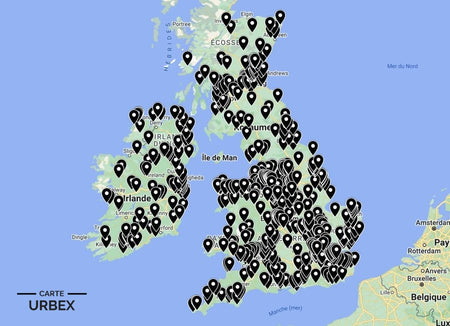
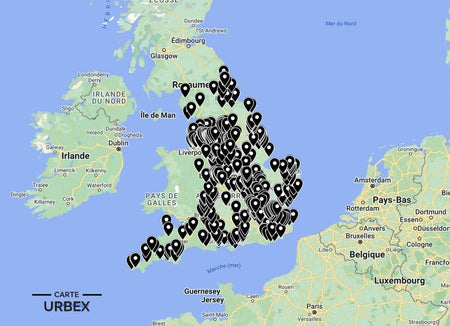
Wigan is one of Greater Manchester's most underrated towns — a former coalfield and textile centre whose George Orwell documented the human cost of its poverty and whose abandoned places span from 19th-century colliery infrastructure to a Victorian power station and a Georgian country house abandoned for decades above the Leeds-Liverpool Canal. The 1992 closure of Bickershaw Colliery ended deep coal mining in the Wigan area after two centuries; the derelict infrastructure it left behind joins Wigan's derelict mills and the atmospheric ruins of Haigh Hall to create an abandoned landscape of unusual historical depth. Here are 5 of the best abandoned places in Wigan, selected from our Abandoned Places Map UK — 640+ GPS locations across England, Scotland, Wales and Ireland.
Why Wigan Is a Hidden Gem for Urban Exploration
Wigan's urbex landscape is defined by the coal and cotton dual-economy that Orwell documented in 1936 — a town that mined coal and wove cotton simultaneously, whose industrial infrastructure spans both trades. The Wigan coalfield's abandoned colliery sites, the Leeds-Liverpool Canal's derelict wharfage and the atmospheric ruins of Haigh Hall create an urbex geography that is largely undocumented outside the Greater Manchester community.
1. Bickershaw Colliery – Leigh, Wigan — 1822-1992 Wigan Coalfield Colliery, Closed 1992, Derelict Infrastructure in the Leigh Setting, Documented by Wigan Urbex Community (Known Location)
Bickershaw Colliery near Leigh was one of the last working pits of the Wigan coalfield — sunk in the 1820s and operating until final closure in 1992, ending a continuous coal mining tradition in the Wigan area that stretched back to at least the 16th century. The colliery's derelict surface infrastructure stands in the Leigh landscape as a monument to an industry that shaped every aspect of Wigan's social, political and economic identity for two centuries. Documented by the Wigan urbex community as the most historically significant piece of derelict coal heritage in the district.
🔗 Learn more: Wikipedia – Bickershaw Colliery
2. Westwood Power Station – Ince, Wigan — Mid-20th Century Coal-Fired Power Station, Turbine Hall and Cooling Infrastructure, Ince-in-Makerfield Setting (Known Location)
Westwood Power Station at Ince-in-Makerfield was a mid-20th-century coal-fired electricity generating station that served the Greater Manchester grid — its turbine hall, cooling infrastructure, and station buildings standing in atmospheric dereliction in the Wigan industrial corridor. The combination of the power station's industrial scale, the flat Wigan coalfield landscape, and the station's position in the network of derelict heavy industry that defines Ince-in-Makerfield make Westwood one of the most dramatically scaled pieces of derelict energy infrastructure in Greater Manchester.
🔗 Also read: Top 5 Abandoned Places in England →

3. Haigh Hall – Haigh, Wigan — 1830s Georgian Mansion, Crawford Estate, Abandoned Sections in Dereliction, Leeds-Liverpool Canal Setting, Documented by Atlas Obscura (Known Location)
Haigh Hall near Wigan is an 1830s Georgian mansion — built for the Earl of Crawford on the former site of a medieval Bradshagh family manor, the hall and its estate dominated the Wigan coalfield from the limestone ridge above the Leeds-Liverpool Canal. Later passing to Wigan Corporation as a public park, significant sections of the hall's interior and outbuildings have fallen into atmospheric dereliction while the grounds remain as a public park. Documented by Atlas Obscura as one of the most atmospheric and most historically layered abandoned hall sites in Greater Manchester.
🔗 Learn more: Atlas Obscura – Haigh Hall Wigan
4. Wigan Victorian Cotton Mill – 1870s-1900s Ring-Spinning Mill, Original Spinning Floors and Engine House, Douglas Valley (Hidden Gem — Our Map Only)
A late Victorian ring-spinning cotton mill in the Douglas Valley — the original spinning floors with their cast-iron columns, the overhead shaft drive infrastructure, and the engine house and ornate chimney of a mill that spun cotton alongside Wigan's coal extraction. Wigan's dual coal-and-cotton economy created an unusual industrial geography where colliery headstocks and mill chimneys occupied the same skyline. GPS coordinates available with our England Urbex Map.
5. Leeds-Liverpool Canal Wharfage Building – 1820s-1840s Canal Warehouse, Leeds-Liverpool Canal, Wigan Pier Corridor (Off the Radar — Our Map Only)
An 1820s-1840s canal wharfage warehouse in the Wigan Pier corridor — the original warehouse infrastructure that served the Leeds-Liverpool Canal's carrying trade through the Wigan coalfield, loading coal from the colliery tramways onto canal boats bound for Liverpool and Lancashire. While the famous Wigan Pier attraction has been developed, peripheral canal warehouse buildings retain derelict sections in atmospheric decay along the canal corridor. Included in our England collection — 400+ locations.
❓ FAQ
What is the most famous abandoned place in Wigan?
Bickershaw Colliery — one of the last working pits of the Wigan coalfield, operating from the 1820s until final closure in 1992. The derelict surface infrastructure is the most historically significant piece of coal heritage in the Wigan district.
What is Haigh Hall?
An 1830s Georgian mansion built for the Earl of Crawford above the Leeds-Liverpool Canal — later passing to Wigan Corporation as a public park, with significant sections of the hall's interior and outbuildings in atmospheric dereliction. Documented by Atlas Obscura as one of the most atmospheric abandoned hall sites in Greater Manchester.
What did George Orwell write about Wigan?
Orwell's The Road to Wigan Pier (1937) documented the living conditions of Wigan's mining and cotton communities during the Great Depression — describing working-class housing, the human cost of coal mining and the culture of the Lancashire town in a work that became one of the defining social documents of 20th-century Britain.
Safety Tips
- Mine shafts: the Wigan coalfield has thousands of capped and uncapped shafts — never approach any ground depression near Bickershaw Colliery or any other pit site
- Power station contamination: Westwood Power Station sites may have residual industrial contamination — wear gloves and never disturb ground surfaces or any contained liquid
- Never explore alone — always bring at least one other person
The urbex code: "Leave it as you found it — the next explorer deserves the same experience."
🎯 Summary
Wigan's abandoned places range from the last colliery of a coalfield that mined coal for two centuries to a mid-20th-century power station whose turbine hall decays in the flat Ince landscape and a Georgian hall above the Leeds-Liverpool Canal whose interior sections are progressively emptying. Each of these 5 derelict buildings in Wigan captures a different layer of the town that Orwell documented and that coal and cotton built.

Abandoned Places Map England
- ✓ 400+ GPS locations across England
- ✓ Exclusive locations not found anywhere else
- ✓ Instant access after purchase
- ✓ Free updates forever
€14.99
Explore All Locations →